Broseley Wood has always been regarded as separate from Broseley itself. There were a small number of shops scattered around village.
King
Street
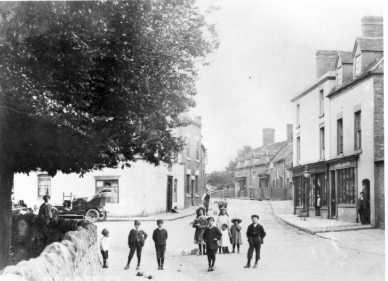
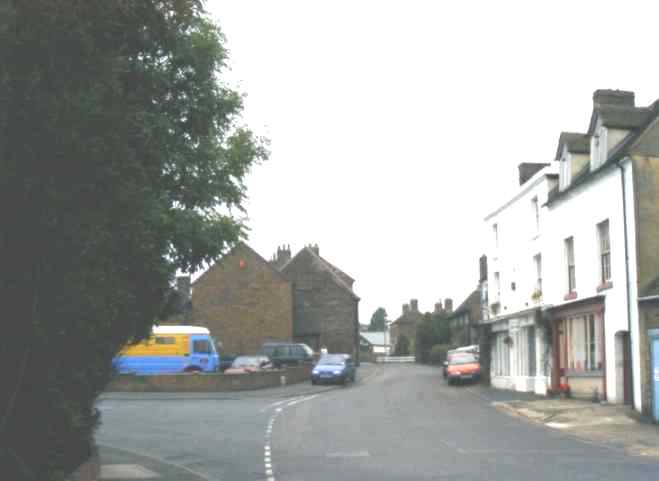
This view on the left was taken in early 1900's shows the junction of King
street and Duke street (we have a Queen street too). On the right is James
Davies shop which at this time sold Coalport China. It later became Hancock's
grocers shop ( "The milky bar shop") which finally closed in the
1980s. On the left is the now demolished Duke of Cumberland Public
House.
The car is from the Garage which was located behind the trees to the
left. In the 1950s this was the "Button Factory" making
yearly some 250,00 mattress buttons and 150 gross of medals and badges
for for Messrs. Gaunt & Co. of Birmingham. These included
defence medals, Red Cross badges, army and R.A.F. badges, car plates etc. It is now, again, a car repair shop.
 Five
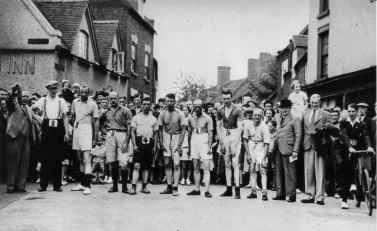
Mile Walking Match 1939
Taken from a similar position to the above view, this photograph shows the 1939 five mile walking race.
This race has recently been revived as a five mile running race by the Broseley Society being run on May Day Bank Holiday from Maypole Green.
The man with the jacket over his arm is the father of Eric Williams of Horsehay. On his left with the bicycle is the father of Guy Tomkiss.
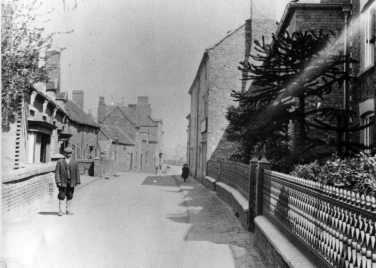 King
Street
This view looks towards the the opposite way up King Street towards the position from which they were taken. It has changed little since this was taken other than the cottages on the immediate left being demolished. The photo was probably taken early in the 20th century.
On the immediate right with the fine railing is Orchard House which is now a B&B. The cast railings have fortunately survived the WW2 scrap drive and are an excellent example of local craftsmanship
Beyond Orchard House is Southorns Pipe works which is now a Museum. At this time it would have been in full production
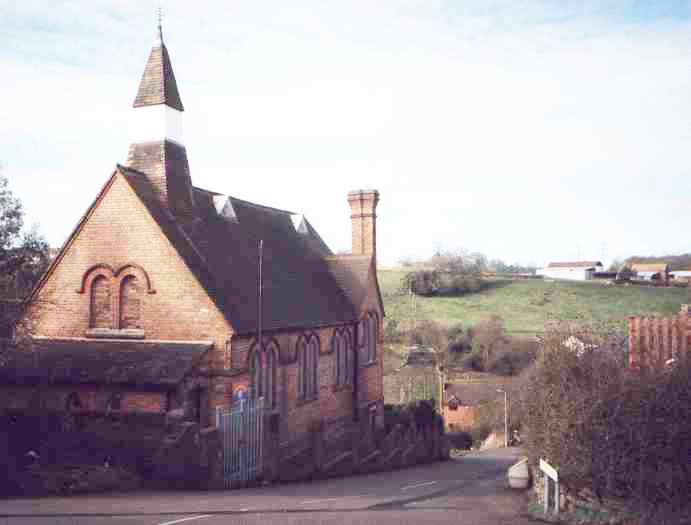 Leggs Hill School.
The building became the Infants Day School for Broseley Wood in 1892 and prior to that it was a Working Men's Institute It was one of two schools in the town which closed in the 1960's when a new primary school was built at Dark Lane. On closure it became the headquarters of the local Territorial Army volunteers and it remains in their occupation.
The hillside on the opposite side of the valley contained shallow mine workings. The mines worked for coal and clay and were in operation until the end of the last century. Their remains are indicated by the disturbed ground.
" I remember going to Legges Hill school. You went there until you were big enough to walk to the school in the Square" - Mrs Hurdley.