Clay Mining
Abandonment Plans
List of Mines in the Broseley Area
1868-1945
Opencast coal
working at Linley Green 1947
Some
mining incidents in the Broseley Coalfield ( Ivor Brown from Journal No 8 -
1980)
More
pictures of Mining Sites in Broseley
Broseley is located in the southern end of the Coalbrookdale coalfield. There
are a number of minerals available notably coal, ironstone, brick, red and tile clays
and limestone to the west of the Broseley Fault, at Benthall. All these
minerals have been exploited over the years. The minerals are at a comparatively
shallow depth and were mined by insetts (adits) into the hillside, by shallow shafts
or in the case of limestone by quarrying.
It has been claimed that coal was mined by the Romans who had a large city nearby at Wroxeter. The first records of mining are from the 15th Century when in 1417-8 John Hadyngton and John Horsley rented a mine from the Lord of the Manor. In the 16th Century Wenlock Priory was involved in mining coal on its lands in Broseley.
This part of Shropshire was pioneering modern techniques of extraction with longwall mining being used to extract coal from the early 17th century. Wooden railways were certainly in use from 1605 when Richard Wilcox and William Wells had a 1km waggonway carrying coal from the Birch batch in Broseley to the river Severn.
In the early 19th century the coal gradually became exhausted. By the 1830's the local furnaces had closed partly because of the exhaustion of coking coal reserves. Ironstone was still however being exported to the Black Country where local ironmasters, such as John Onions, had built new works. Extraction continued until the 1880's however the scale of extraction was relatively small with only 126 people being employed at mines in Broseley in 1840.
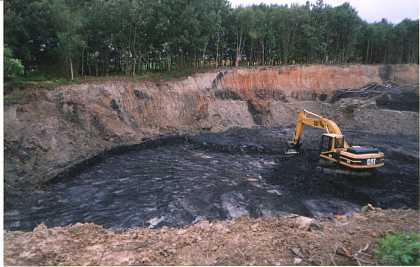
The mining of clay and a little coal for the manufacture of bricks and tiles continued until the 1950's. The reworking of shallow seams for coal and clay by opencast methods started in mid 20th century at Benthall and Linley Green in 1947 (see article). It still continues (1999) at Caughley on the site where coal was extracted and taken to the Severn on a waggonway in the 18th century.
There is extensive archeological evidence of early 19th century mining in the large spoil heaps associated with ironstone mining. These are substantial clay mounds usually with a shaft on the top which are the waste heaps from mining the pennystone ironstone. This seam comprised a matrix of nodules of ironstone in clay. The clay containing the ironstone was mined and dumped on the heap to weather. Normally women would be employed to pick the nodules of ironstone from the clay which they would carry in wooden boxes on their head. Because the clay was spread all around the shaft as the heap grew in height so did the shaft.
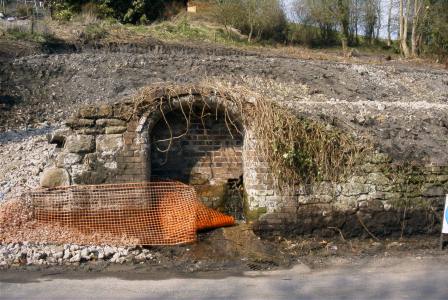
As the mineral seams were at a shallow depth many of the mines were drift
mines going horizontally into the hillside. The remains of one such mine, from
which water continually flows, can be seen near the New Inn on Bridge Road Benthall.
Like most of the mines in the area there is no record of when the mine was
operating or what minerals were worked. =>
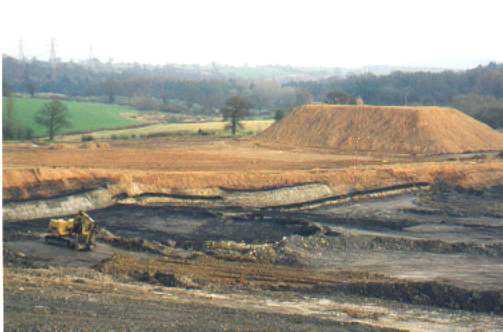
At the Posenhall to the west of Broseley in the late 1990's Clay Colliery
Company were
extracting coal and fireclay. The workings lie at the very edge of the
coalfield where the lowest seams in the series are close to the surface. As well
being able to see the two coal seams being worked, faulting in the strata is
evident to the right of the excavator.=>
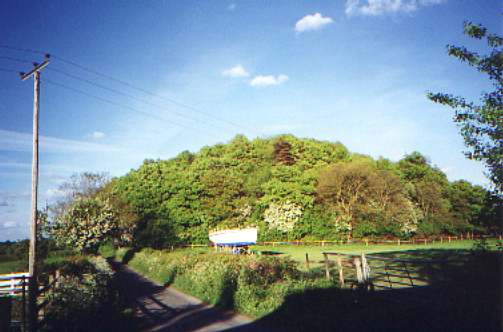
The most substantial remains of mining are the waste heaps from mining the
pennystone ironstone. The main period of working for pennystone was from
the late 18th Century to the mid 19th. These have been planted with trees which make them
particularly attractive in summer. Below is the Barnetts Leasow
mine. It was probably worked in association with the nearby Barnetts Leasow
furnaces which opened in 1797 by Jesson & Wright. In 1838 it was being worked
for ironstone by James Foster who owned
the Madeley Court Ironworks across the river. It is however more likely, that
at this time the ironstone from this mine was being taken by tramway to the
Severn and shipped to one of his furnaces in the Black Country. =>
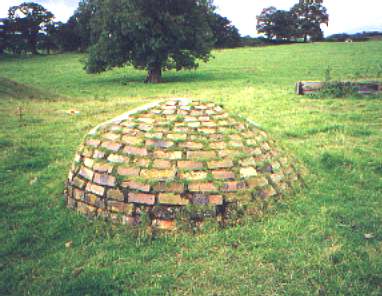 In
the early days of mining it was normally a requirement of the lease that
the shaft was filled and the land returned to its original state. Later
shafts were capped, usually with a brick dome. In some cases it is
reported that shafts were blocked by putting planks of wood into the cage and
dropping it into the shaft. Some years later when the cage rotted
the shaft unexpectedly re-opened.
Left i is the cap for the shaft at Turners yard mine Caughley, which was108' deep and 5' diameter. Surviving shafts are curricular and brick lined with a typical diameter of 6' 6". Earlier mines, exposed by opencast workings, often had square shafts lined with timber.
This mine fell out of use in the early 20th century but underground mining continued from a nearby until the 1950's..
Opencast mining started some time after the underground mining stopped. This
was on a site some hundred of metres to the south of shaft at
Turners Yard. As at Posenhall, two miles to the west the seams are at a
shallow depth. Mining here took place in the late 18th century but little evidence
can be seen of this. Extraction of coal is still continuing (Dec
1999). =>